
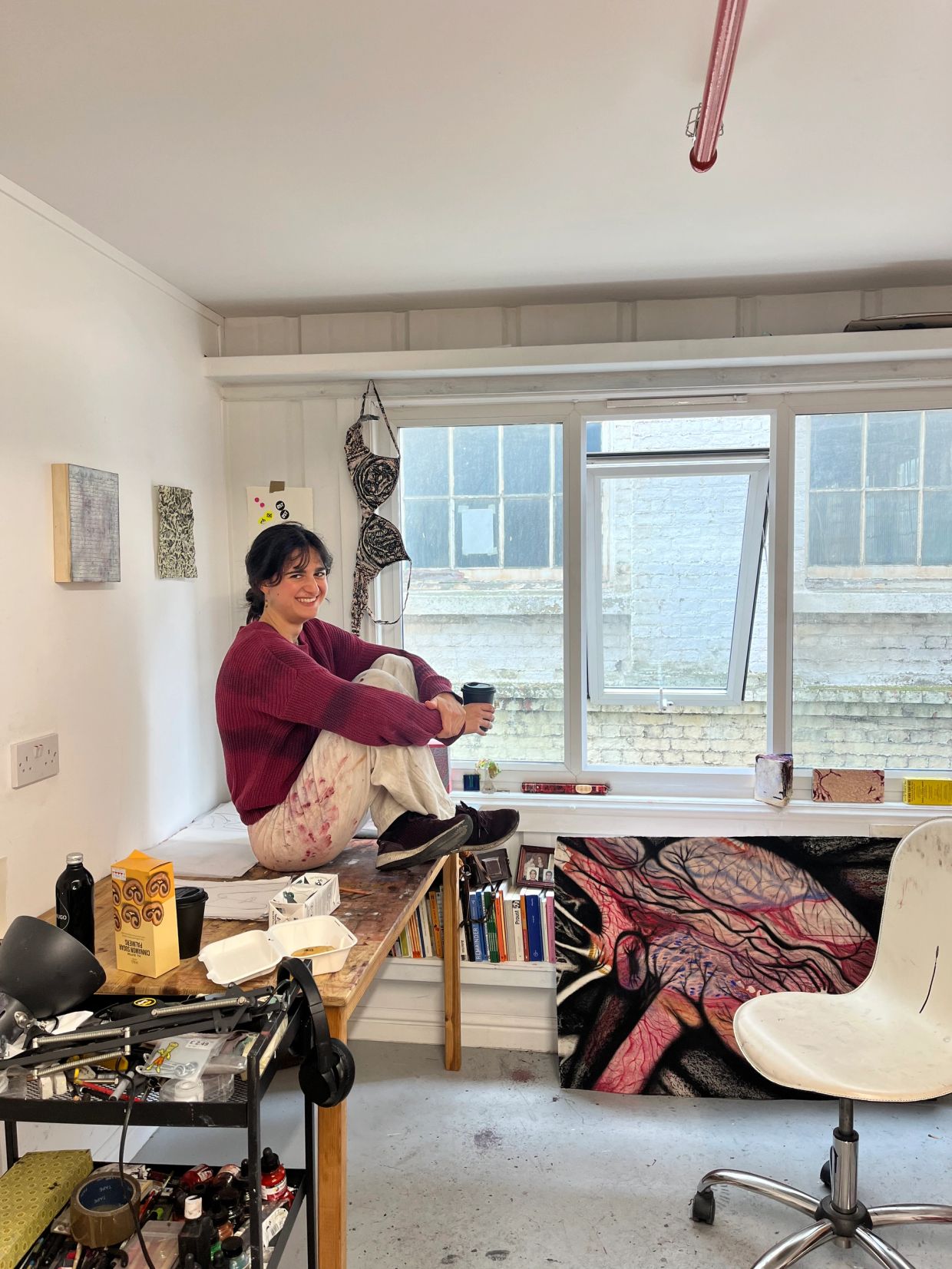
Sometimes memory arrives as a still image, preserving those habited places with clarity. At other times, it is a single detail—a texture, a colour or a pattern—that unexpectedly transports us to a fixed moment in the past. Entering Rita Fernández's studio in Woolwich, it is the latter experience that unfolds. The space itself becomes an extension of her imagination: a landscape where memories, dreams and lived experience converge. Every object, surface and unfinished work appears to belong to a wider personal cartography, revealing an artistic practice rooted in intimate recollection and the unconscious.
Fernández's paintings and drawings emerge from an intensely personal inner world, one populated by stories that oscillate between autobiographical memory and dream imagery. Rather than constructing linear narratives, her works create psychological spaces in which reality and imagination collapse into one another. Rather than treating memory as private confession, Fernández transforms intimate experience into a language through which broader questions of womanhood, desire and embodiment can be explored.
Top image: Weeding, 2025, underwear cutting, oil bars and oil on canvas, 40 cm x 55 cm
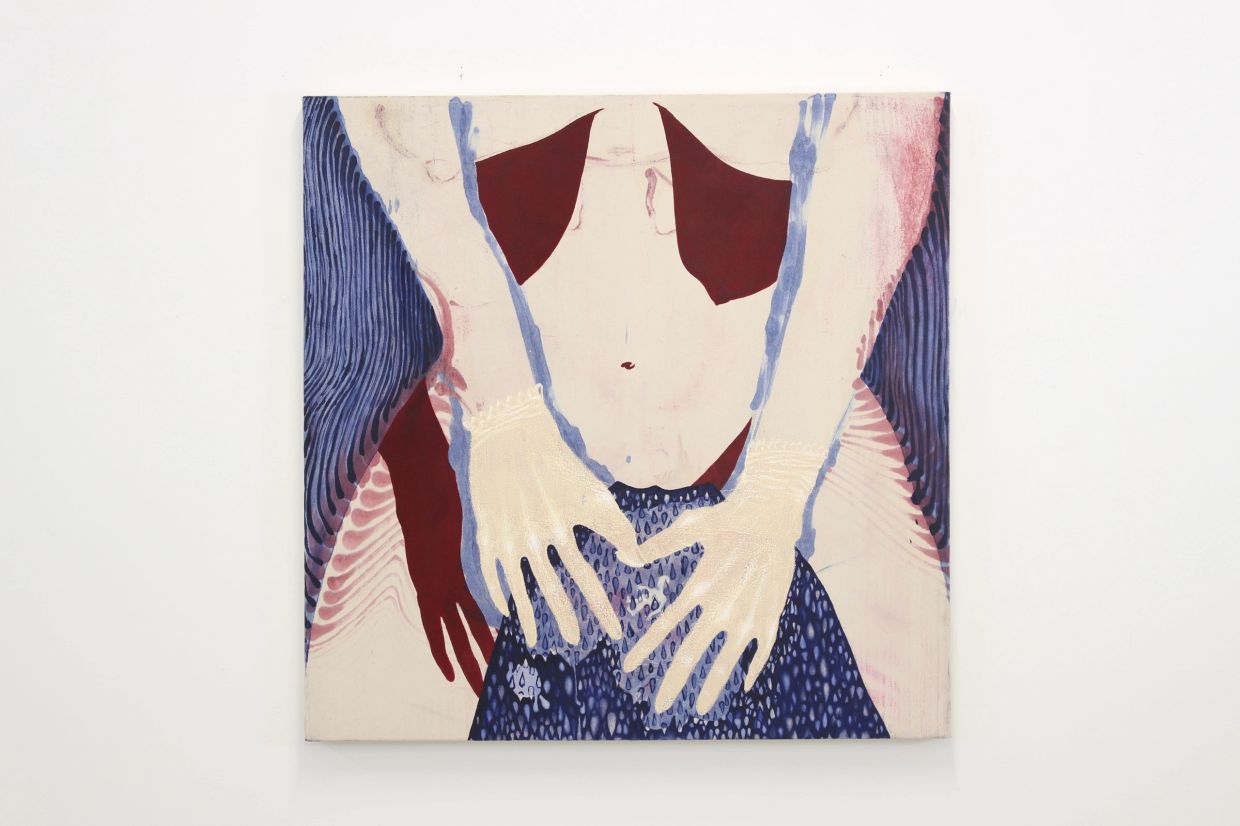
Rain gloves, 2026, oil and oil bars on canvas, 80 cm x 80 cm. Courtesy of the artist.
Pattern plays a fundamental role throughout Rita's practice. Many of these motifs originate from an ongoing process of experimentation with textiles, particularly pieces of old underwear that she has preserved over time. These garments are not presented as nostalgic relics but instead become tools for mark-making.
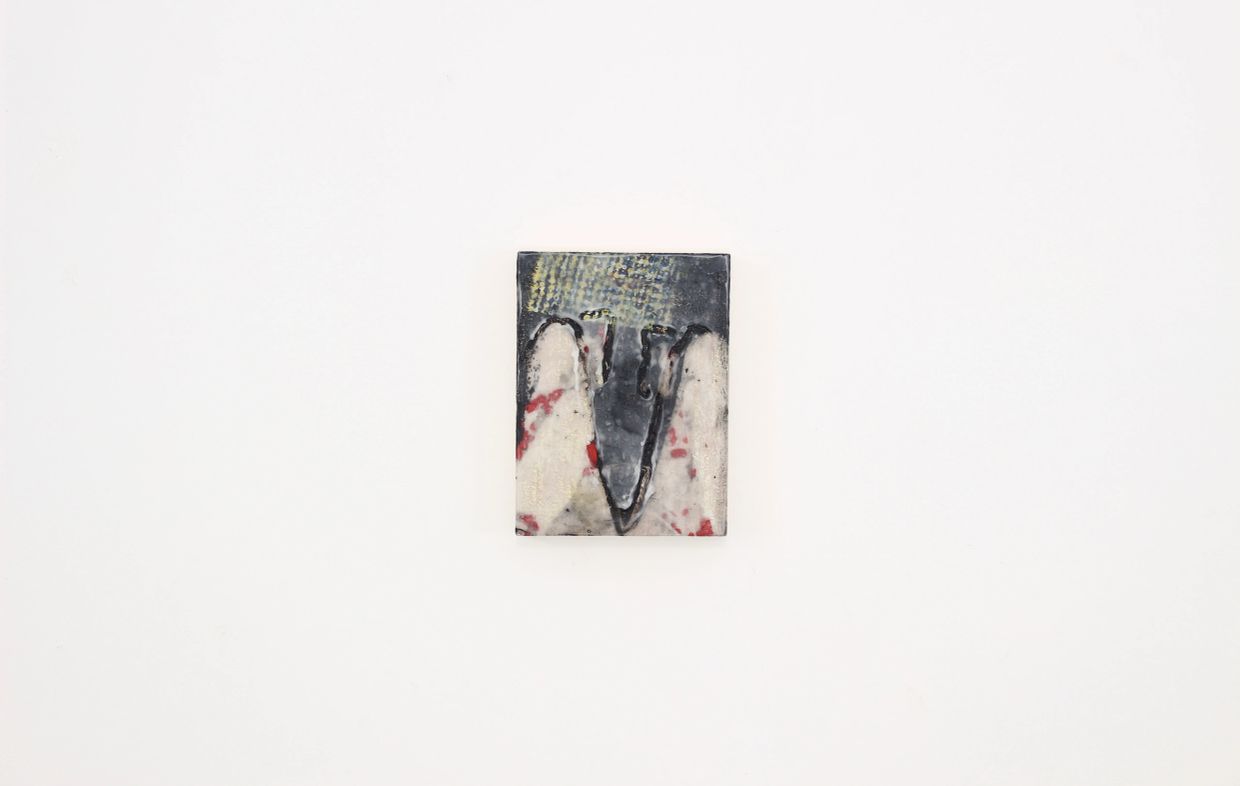
In one of her recent works, Rain Gloves, Rita depicts the torso of a naked female figure seated with her legs apart, her gloved hands resting upon a patterned blue mound. The composition plays with the tension between flat, simplified forms and richly textured surfaces. The mound bears the imprint of the creases and wrinkles of an old brassiere, transformed into improvised stamps that allow the fabric to inscribe itself onto the painted surface. Waves, lines and rhythmic repetitions extend across the background, creating a dynamic field from which the white silhouettes of the body and hands emerge. The open pose of the figure is countered by the concealment of the gloves and the abstracted treatment of the body, producing an image that oscillates between erotic suggestion and formal experimentation. At other times, as in the artwork Home, Rita inverts these clear shapes of the body, making abstract presences or luminous voids the protagonists.

Home, 2025, beeswax and oil on wood, 20 cm x 25 cm. Courtesy of the artist.

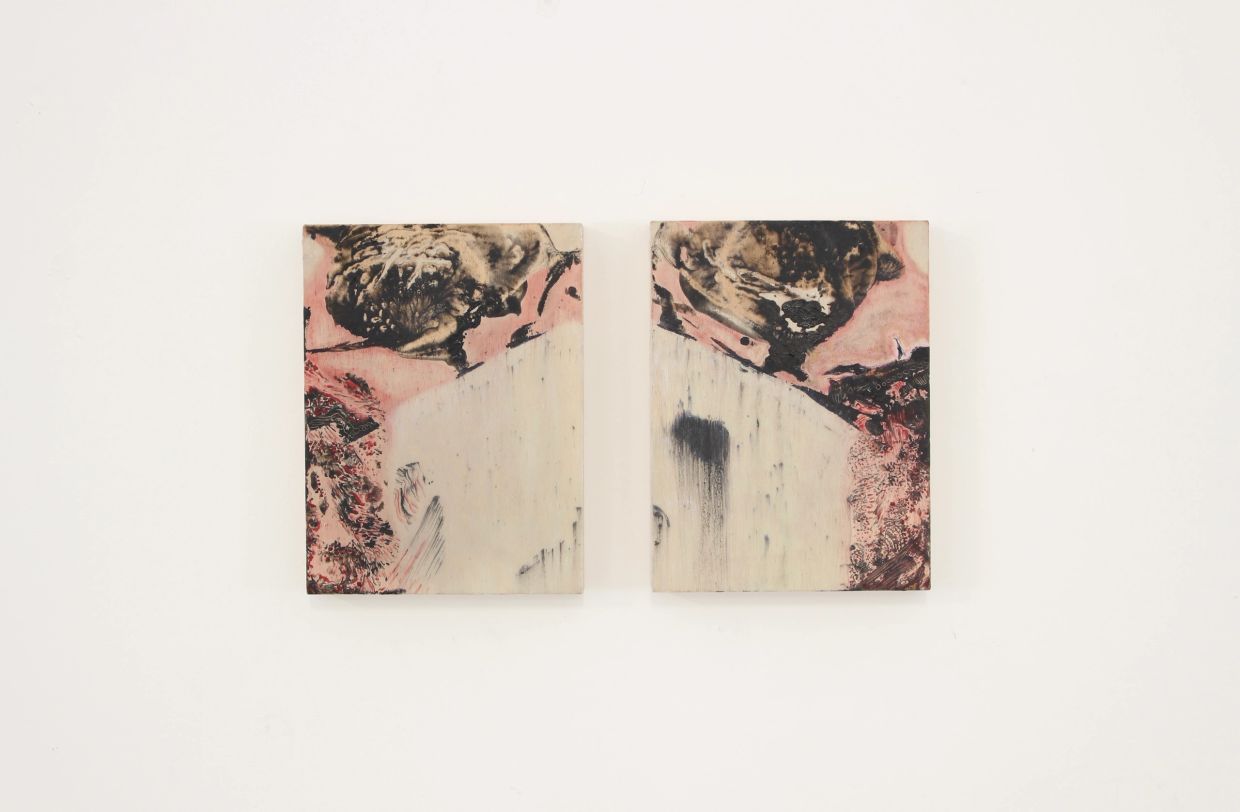
Throughout her paintings, female sexuality is present both directly and indirectly. It emerges through fragmentation, layering and suggestion, as in Gangrene. While the image remains deliberately ambiguous, it carries a clear bodily connotation: perhaps a heart, perhaps the lateral view of a uterus. A fragment of the human body, surrounded by a black halo, foreshadows a sense of loss, as the title itself suggests. Ideas of vulnerability, illness and absence converge in this abstract form, evoking flesh, skin and interior spaces. This interplay between abstraction and corporeality, the work gestures towards female sexuality through indirection rather than explicit representation. Fernandez's paintings speak through material, texture and colour, producing a visual language that is fluid rather than descriptive.
Dreams occupy an equally significant place within her practice. Her compositions often unfold with the irrational logic of the subconscious, where ordinary objects become charged with symbolic meaning. A tree grows branches only to sever them with a pair of scissors; elsewhere, a dinner plate overflows not with food but with worms. Fernandez recounts that this latter image, resulting in her drawing Abre la boca (open your mouth), originated both from memory and from a dream. As a child visiting her aunt's house, she was expected to finish every meal. Years later, this memory resurfaced in sleep, transformed into a disturbing vision. Rather than illustrating dreams, these works reveal how memory itself becomes unstable, continually rewritten by the unconscious.

Rita in her studio. Photo by Sara Sahores. June, 2026.

Gangrene, 2026, ink, gouache and charcoal on paper, 70 cm x 100 cm. Courtesy of the artist.
Colour is equally central to Fernandez's visual language. Her paintings often inhabit an atmosphere of deep blues, violets and saturated purples, interrupted by vivid reds and pinks. These colours evoke bodily interiors rather than external appearances, recalling blood, menstrual fluids, flesh and organic matter. Rather than seeking harmony or idealised beauty, Fernandez embraces a palette that speaks of the body's materiality, vulnerability and constant transformation. In doing so, her work evokes a sense of abjection, inhabiting the unstable threshold between attraction and discomfort, intimacy and exposure. The body is neither idealised nor sanitised; instead, it appears as a site where beauty, fragility and corporeality coexist.
This tension between concealment and revelation is amplified in a series of works constructed with translucent layers of white wax. Wax simultaneously obscures and reveals the painted surface beneath, allowing marks to emerge only partially through its skin-like membrane. In the artwork Veiled, the wax partially covers the image of a woman's legs, seen from the perspective of the figure herself. It is an intimate and vulnerable image: sitting naked and looking down at one's own body, whether in the bathroom or on the edge of a bed. This viewpoint recurs throughout Rita's practice, generating a sense of intimacy while also recalling notions of abjection. Again in Veiled, drawn lines hover delicately across these layers, suggesting memories that can never be fully recovered. The material itself becomes a metaphor for memory: protective yet fragile, capable of preserving traces while remaining mutable. Here, opacity is understood not as absence but as a refusal of complete visibility—a quality that resonates with Édouard Glissant's notion of the "right to opacity", allowing identity to remain complex rather than fully legible.

Veiled, 2025, ink, beeswax, oil bars and oil on wood, 20 cm x 10 cm. Courtesy of the artist.
Throughout her practice, Fernández moves fluidly between places and temporalities. Memories of Mexico intersect with experiences of life in London, while dreams collapse distinctions between past and present. Rather than documenting these locations, she reconstructs them through emotional associations, allowing recollection to become layered, fragmented and continually transformed.
Ultimately, Rita Fernández's work invites us to inhabit a space where memory is neither fixed nor reliable, but constantly rewritten through dreams, material processes and bodily experience. Her paintings do not seek to illustrate personal history; instead, they translate its emotional residue into a visual language rich in texture, colour and symbolic ambiguity. In doing so, they remind us that our most intimate memories rarely return intact. Instead, they resurface as fragments, sensations and images—quietly insisting on being seen once again.

Artist in her studio at Woolwich, London, 2026. Photo by LATAMesa
Words by Carolina Orlando.
June, 2026. London, UK.
Copyright © 2023 latamesa.co.uk - All Rights Reserved.
INSTAGRAM: @LATAMESA
EMAIL: LATAMESA.LDN@GMAIL.COM